A HubSpot partner can know the software and still misunderstand how a manufacturer sells.
Manufacturing teams work across long buying cycles, technical stakeholders, distributors, plants, quoting tools, ERPs, and service handoffs. If an implementation partner treats that environment like a simple lead-to-deal funnel, the CRM may look polished while the underlying operating problems remain.
This checklist helps manufacturing revenue leaders evaluate HubSpot implementation partners on the technical and operational evidence that matters before a project begins.
Quick takeaways
-
HubSpot expertise is necessary, but manufacturing process design is the real test.
-
Ask for artifacts such as a data model, system-of-record matrix, integration design, acceptance criteria, and adoption plan.
-
The partner should account for plants, distributors, products, quotes, orders, service, and exceptions - not only contacts and deals.
-
Score every partner against the same evidence before comparing price or timeline.
Why manufacturing needs a HubSpot-specific partner checklist
A standard HubSpot implementation may configure lifecycle stages, pipelines, workflows, dashboards, and email automation. A manufacturing implementation must also decide how those elements interact with operational systems and real-world selling motions.
Questions quickly become more complex:
-
Is the customer record the parent company, an individual plant, a dealer, or all three?
-
Does HubSpot or the ERP own product, pricing, order, and fulfillment data?
-
How should opportunities represent engineering review, samples, RFQs, distributor involvement, and procurement?
-
What should happen when a quote changes, an order is delayed, or an account is reassigned?
The right partner should make these decisions explicit before building. Use the following 11 checks to determine whether a proposed engagement is designed for your operating reality.
The 11 HubSpot partner checks for manufacturing teams
1. Can the partner map the process beyond closed won?
Ask the partner to map one representative customer journey from initial demand through qualification, technical review, quote, order, fulfillment, service, and expansion. The map should name owners, systems, required information, approvals, and exceptions.
A map that ends at closed won misses the point. Manufacturing revenue data often becomes more valuable after the order moves into operations.
Evidence to request: A cross-functional process map that includes marketing, sales, engineering, operations, finance, and service.
2. Does the proposed HubSpot data model reflect complex accounts?
Manufacturers may sell to a corporate parent while serving multiple plants, branches, distributors, contractors, and end users. A flat company record can hide buying relationships and create duplicate ownership.
The partner should explain how it will represent account hierarchies, buying committees, locations, channel relationships, and product interest without turning the CRM into a maze.
Evidence to request: A sample entity-relationship diagram and rules for record creation, association, and deduplication.
3. Are pipeline stages tied to verifiable buyer or operational events?
Labels such as “qualified” and “proposal sent” are too vague when multiple teams touch a deal. Each stage should have an entry rule, an exit rule, required properties, and a clear owner.
For example, a technical validation stage might require a confirmed application, decision participants, required specifications, and an assigned engineering reviewer. This improves forecasting and reduces subjective stage updates.
Evidence to request: A pipeline specification with stage definitions, required fields, probabilities, and exception paths.
4. Has the partner defined which system owns each data point?
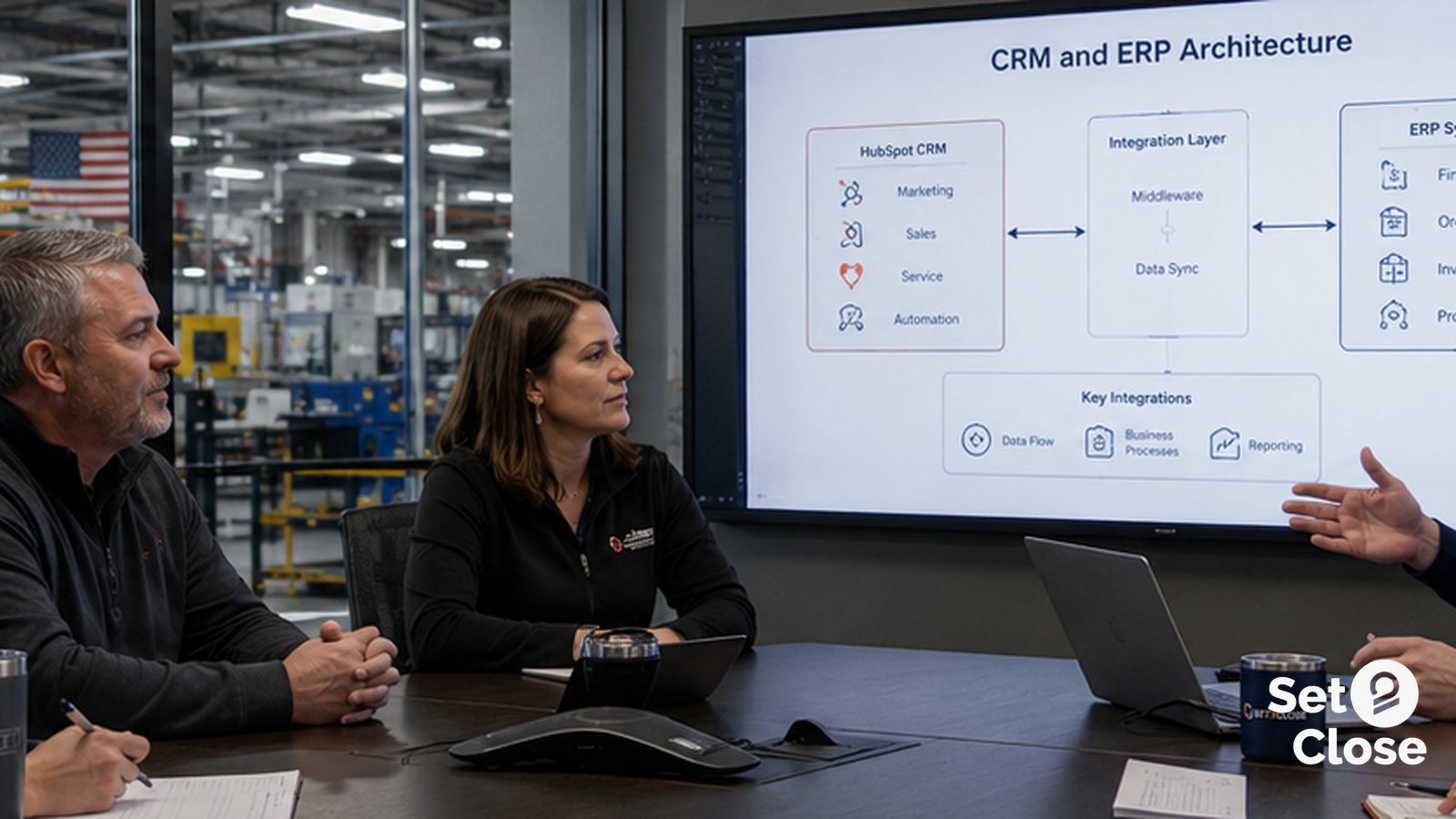
Before anyone connects HubSpot to an ERP, CPQ, or quoting system, the team needs a source-of-truth decision for every critical object and field. Otherwise, two-way synchronization can create conflicts, overwrite trusted values, or trigger the wrong automation.
A credible partner will separate customer engagement data from operational master data and document the rules for each direction of sync.
Evidence to request: A system-of-record matrix listing the owning platform, sync direction, frequency, transformation, and conflict rule.
5. Can the integration design survive exceptions?
“We integrate with ERPs” is not enough. Ask what happens when a required identifier is missing, a product code is retired, a customer exists twice, a quote is revised, or an API call fails.
The design should include monitoring, retries, error ownership, reconciliation, and a safe way to reprocess failed records. A successful demo is not the same as a supportable production integration.
Evidence to request: An integration sequence diagram plus an error-handling and reconciliation plan.
6. Does the migration plan protect history and reporting?
Manufacturing CRM records often contain years of activity, inconsistent naming, outdated owners, and legacy relationships. Moving everything without rules simply transfers the disorder.
The partner should define what will be migrated, transformed, archived, merged, or excluded. It should also explain how legacy stage history and source data will affect reporting after launch.
Evidence to request: A field-level migration workbook, sample transformation rules, and a reconciliation report.
7. Are workflows designed around service levels and exceptions?
Automation should support a defined process, not compensate for an undefined one. Lead routing, deal assignment, approvals, follow-up, and escalation workflows need named owners and service-level expectations.
Ask the partner to show how a workflow handles missing territory data, shared accounts, inactive owners, distributor leads, and high-value exceptions. The unhappy path reveals more than the ideal path.
Evidence to request: Workflow specifications with triggers, suppression rules, exception branches, alerts, and owners.
8. Will dashboards answer manufacturing leadership questions?
Activity dashboards are easy to build. Decision dashboards are harder. Manufacturing leaders need visibility into pipeline by product family, plant, territory, channel, application, sales stage, and expected order timing.
The partner should trace every KPI to a reliable field, owner, update rule, and quality check. If the data cannot support a decision, the dashboard is decoration.
Evidence to request: A reporting requirements matrix that connects each decision to a definition and source field.
9. Is governance part of the implementation, not an afterthought?
HubSpot changes after launch. Teams add properties, lists, workflows, integrations, and reports. Without governance, the portal becomes harder to trust every quarter.
Look for naming standards, change approval, documentation, testing, access controls, and an owner for every critical automation. Governance should be usable by the internal team, not dependent on the partner forever.
Evidence to request: A governance charter, asset inventory, naming convention, and change-request process.
10. Does the adoption plan fit field and channel teams?
Training should reflect how people actually work. A field salesperson, sales coordinator, channel manager, engineer, and executive do not need the same screens or instruction.
The partner should reduce unnecessary fields, design role-based views, create job-specific scenarios, and measure whether required actions occur after training.
Evidence to request: Role-based enablement plans, acceptance scenarios, office-hour support, and an adoption dashboard.
11. Are scope, acceptance, and ownership unambiguous?
A strong statement of work separates discovery assumptions from approved requirements and defines what “done” means. It names client responsibilities, partner responsibilities, dependencies, decision deadlines, and the process for handling changes.
Compare partners on deliverables and acceptance criteria, not just a list of HubSpot features.
Evidence to request: A deliverable register with owner, due date, acceptance test, dependency, and change-control rule.
 Manufacturing HubSpot partner scorecard
| Evaluation area | Strong evidence | Warning sign |
|---|---|---|
| Process | Cross-functional map through order and service | Generic funnel ending at closed won |
| Data model | Account, location, channel, and buying-group design | Only contacts, companies, and deals |
| Integration | Ownership, errors, monitoring, and reconciliation | “Two-way sync” without operating rules |
| Automation | Service levels, exceptions, and named owners | Happy-path workflows only |
| Adoption | Role-based scenarios and measured usage | One generic training session |
| Governance | Standards, documentation, and change control | No plan for post-launch changes |
How to use the checklist during partner selection
-
Choose two representative use cases: one normal revenue path and one difficult exception.
-
Ask every shortlisted partner to explain how it would model both cases.
-
Score the evidence from 0 to 2: no evidence, partial evidence, or clear artifact and example.
-
Separate must-have gaps from items that can be resolved during discovery.
-
Compare the statement of work against the promised approach before signing.
This process makes partner selection more defensible and exposes implementation risk before it becomes expensive.
FAQs about HubSpot partners for manufacturing
What should a manufacturing company look for in a HubSpot partner?
Look for evidence of complex account design, manufacturing process mapping, ERP or CPQ integration planning, data governance, role-based adoption, and measurable acceptance tests. Platform certifications alone do not prove operational fit.
Does a HubSpot partner need experience with our exact ERP?
Exact product experience can help, but the deeper requirement is a disciplined integration method. The partner should define system ownership, identifiers, transformations, failure handling, reconciliation, security, and support responsibilities.
How should we compare HubSpot implementation proposals?
Normalize proposals into deliverables, dependencies, owners, assumptions, and acceptance criteria. A lower price may exclude discovery, data cleanup, testing, enablement, or post-launch support that another proposal includes.
When should discovery happen?
Initial discovery should happen before final scoping, with deeper design discovery after selection. Be cautious when a partner promises a fixed solution before it has mapped your process, data, systems, users, and exceptions.
What is the difference between HubSpot configuration and a manufacturing revenue system?
Configuration activates CRM features. A manufacturing revenue system connects those features to account structures, quoting, operational data, team handoffs, governance, and decisions across the customer lifecycle.
Choose evidence over a polished demo
The best manufacturing HubSpot partner is not the one that shows the most features. It is the one that can translate your revenue process into a governed, testable system your team can operate.
If you want help mapping the requirements before you compare proposals, start with a manufacturing HubSpot readiness conversation.
Related Articles