
Fractional RevOps vs Hiring In-House: Full Cost Compared
The short answer
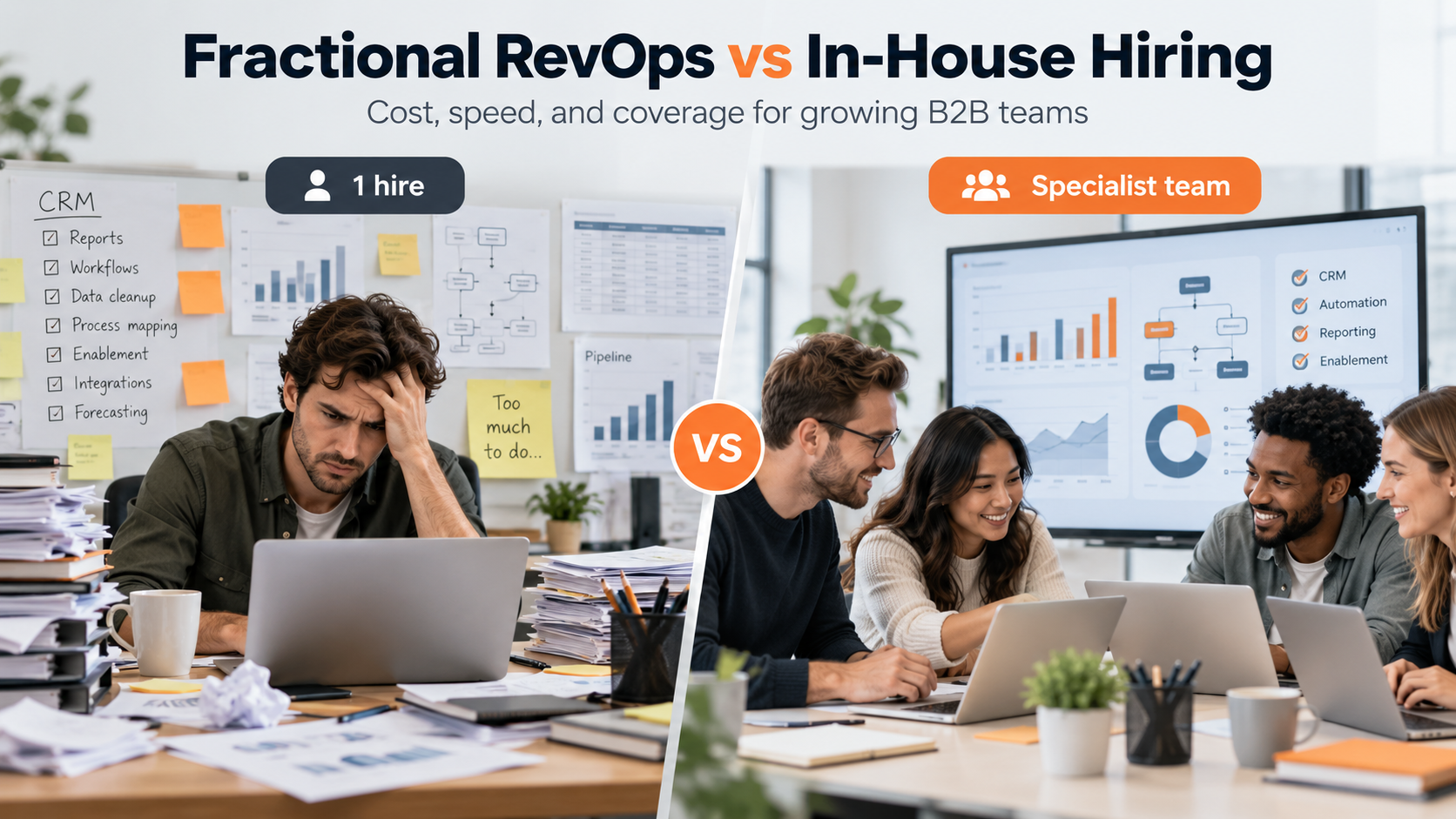
For most B2B companies between $5M and $50M in revenue, fractional RevOps beats hiring in-house on cost, speed and coverage. One internal RevOps manager costs about $246K in year one once salary, bonus, benefits, recruiting and ramp are counted, and that one person realistically covers one or two of the five disciplines RevOps requires. A fractional RevOps team typically runs $5K to $18K a month, brings strategy, CRM architecture, automation, reporting and enablement as a bench, and starts producing in weeks instead of the six to eight months a new hire needs to ramp.
Hire in-house when RevOps work fills more than 40 hours a week, your GTM motion is complex enough to need daily institutional context, and the playbook already exists for that person to run. Until then, fractional is the lower risk, faster path.
What is fractional RevOps?
Fractional RevOps is an outsourced revenue operations team that owns your CRM, processes, data and reporting on a monthly retainer instead of a full-time salary. You get senior judgment plus hands-on execution across sales, marketing and customer success, without recruiting, benefits or ramp time.
The key difference from hiring is breadth. An internal hire is one person with one skill set. A fractional engagement gives you a team of specialists who have solved the same problems across hundreds of CRMs, and who document everything so an eventual internal hire inherits a working system instead of a mess.
At Set2Close, fractional RevOps runs on the RevOps Blueprint: a five-pillar program built on HubSpot, delivered by a HubSpot Elite Solutions Partner team that has served more than 550 clients.
Why one hire can't cover RevOps
RevOps is five jobs, not one. When companies post a single "RevOps Manager" req, they are asking one person to be a strategist, a CRM architect, an integration engineer, a data analyst and a change manager at once. The market prices each of those as a separate role.
| Discipline | What it covers | Closest specialist title | 2026 US base salary |
|---|---|---|---|
| Strategy and process design | Funnel stages, lifecycle definitions, handoff SLAs, territory and routing logic | RevOps Manager | $100K to $140K |
| Integration and automation | Workflows, APIs, data sync between CRM, ERP, billing and outreach tools | RevOps / GTM Operations Engineer | $110K to $150K |
| Data, reporting and forecasting | Dashboards, attribution, pipeline coverage, forecast accuracy | Senior RevOps Analyst | $90K to $120K |
| CRM architecture and administration | Properties, pipelines, permissions, data hygiene, deduplication | RevOps Specialist | $75K to $105K |
| Enablement and adoption | Training reps, documentation, getting the team to actually use the system | Not benchmarked; usually falls on the sales leader | Rarely budgeted |
Salary ranges: SyncGTM RevOps Salary Guide 2026.
Staffing the first four with one hire each would cost roughly $420K in base salary alone. So companies hire one person and hope. What actually happens is predictable: the hire gravitates to the discipline they are strongest in, and the other four stay broken. A strong analyst builds beautiful dashboards on dirty data. A strong admin cleans the CRM but nobody defines the funnel. A strong strategist writes the plan but can't build the workflows.
The talent market makes this worse. SyncGTM estimates about 2.3 open RevOps roles for every qualified candidate in 2026, with average time to fill rising to 47 days. You are competing for a scarce generalist, and the strongest ones are increasingly choosing consulting over full-time roles.
The full cost of one internal RevOps hire vs a fractional team
A single internal RevOps manager costs about $246K in year one. A fractional team at a typical $10K a month costs $120K and covers more disciplines. Salary is only half of what the hire really costs.
| Cost line | Internal hire, year 1 | Fractional team, year 1 | Basis |
|---|---|---|---|
| Base salary | $120,000 | Included | Midpoint of the $100K to $140K RevOps Manager range (SyncGTM) |
| Bonus | $18,000 | $0 | 15%, midpoint of the typical 10 to 20% RevOps bonus (SyncGTM) |
| Benefits and payroll taxes | $36,000 | $0 | 30% of salary; benefits are 31.5% of total compensation for full-time private-industry workers (BLS, June 2026) |
| Recruiting | $27,000 | $0 | Agency fees of 20 to 25% of first-year salary (Noon, citing SHRM) |
| Lost productivity during ramp | $40,000 | Minimal | SHRM estimate of output lost while a new hire ramps (Hyring) |
| Tools, training and certifications | $5,000 | Included | Set2Close estimate |
| Fractional retainer | $0 | $120,000 | $10K a month, midpoint of the typical $7K to $12K retainer (Prospeo) |
| Total | $246,000 | $120,000 |
Over three years, the gap grows to $262K
| Cumulative cost | Year 1 | Year 2 | Year 3 |
|---|---|---|---|
| One internal RevOps hire | $246K | $431K | $622K |
| Fractional RevOps team | $120K | $240K | $360K |
Internal hire cost grows 3.3% a year per the BLS compensation trend; fractional modeled at $10K a month.
This model is conservative. It leaves out the cost of the empty seat while you recruit, the hours your VP of Sales spends managing and unblocking the hire, and the cost of a hire who doesn't work out, which is covered below. Year two drops to about $185K for the internal hire, but you are still paying a team price for one person's coverage.
Ramp time: months versus weeks
An internal RevOps hire typically reaches full productivity 8 to 10 months after you open the req. A fractional team is typically productive within one to two weeks of kickoff, because it is not learning RevOps on your time.
| Milestone | Internal hire | Fractional team |
|---|---|---|
| Find and sign the right person | About 47 days average time to fill (SyncGTM) | Days: scope call and statement of work |
| Start date | Plus 2 to 4 weeks notice period | Kickoff the following week |
| Learn your business, CRM and data | Bundled into ramp | Structured audit in the first 1 to 2 weeks |
| Reach full productivity | 6 to 8 months after start for most professional roles (Hyring) | 1 to 2 weeks (Prospeo) |
| Total from decision to full output | About 8 to 10 months | About 2 to 4 weeks |
That gap is the real cost. Every month your forecast is unreliable, leads route to the wrong rep or attribution is a guess, the business makes decisions on bad data. A RevOps hire who ramps in Q1 means the fixes land in Q3 or Q4. A fractional team means they land this quarter.
Set2Close backs its HubSpot implementations with a guarantee: Live in 30 Days or We Fix It. That is a commitment no single new hire can make.
Capability gaps, execution risk and continuity
The internal model concentrates all of your RevOps risk in one person. The fractional model spreads it across a team with documented processes. Here is how the two compare on the risks that actually stall revenue teams.
| Risk | Internal hire | Fractional RevOps team |
|---|---|---|
| Capability gaps | One skill set; the other disciplines stay broken or get outsourced anyway | Strategy, architecture, automation, reporting and enablement on one bench |
| Pattern recognition | Has seen a handful of CRMs | Has seen hundreds of CRMs and the same failure modes repeat |
| Execution capacity | One person's hours, shared with every ad hoc report request | Capacity flexes up for a migration or launch, down when steady |
| Vacation, illness, resignation | Work stops; knowledge leaves with them | Coverage continues; work is documented in the CRM and playbooks |
| Accountability | Performance managed by a sales leader who may not know RevOps | Contracted deliverables, scope and outcomes |
| Exit cost | Months of severance risk, rehire and re-ramp | A notice period on the retainer |
Continuity is the risk most companies underestimate. When your only RevOps person leaves, the routing rules, the custom properties, the workflow logic and the reason behind each one leave with them. The replacement spends their first months reverse engineering what the last person built. A fractional partner builds in documentation as part of the work, so the system survives any single person.
Execution risk compounds the capability gap. A solo hire spends most of their week on reactive requests: a new field here, a broken report there. Strategic work, like redefining lifecycle stages or rebuilding the forecast, never gets the uninterrupted time it needs. Prospeo describes the failure mode well: RevOps done badly becomes reactive ticket-taking, with no real process improvement (Prospeo).
What happens if the internal hire doesn't work out
If your RevOps hire fails, you lose about $190K and roughly 18 months before a productive replacement is in the seat. This is not an edge case. Leadership IQ tracked 20,000 hires and found 46% fail within 18 months (Noon), and the U.S. Department of Labor puts the direct cost of a bad hire at 30% of first-year earnings, closer to 50% for managerial roles (The Lonely Entrepreneur).
Here is how a failed RevOps hire typically plays out:
- Month 0: You open the req.
- Month 2 to 3: The hire starts after about 47 days of recruiting plus a notice period. You have spent about $27K in recruiting.
- Months 3 to 9: They ramp, take on reactive requests and start a few projects. Leadership senses it isn't working by month three or four but waits, hoping it improves. The same Lonely Entrepreneur analysis notes most founders know within 90 days but act around month nine.
- Month 9: You part ways. You have paid about $94K in loaded compensation for partial output, and half finished projects now need to be audited or undone.
- Months 9 to 12: The seat is empty again. Recruiting starts over for another $27K.
- Months 12 to 18: The replacement ramps, losing about $40K more in productivity, while reverse engineering what their predecessor built.
Add it up and the business has spent roughly $190K and lost a year and a half of RevOps progress. Meanwhile, forecasts stayed unreliable, leads kept leaking and the CRM got messier.
The same failure in a fractional engagement looks very different. If the fit is wrong, you give notice on the retainer, and because the work is documented, a new provider or an internal hire picks it up without starting from zero. The downside is measured in weeks, not years.
When hiring in-house is the right call
Hiring in-house makes sense once RevOps is a full-time, stable workload and the system already works. Fractional is not the answer for every company forever, and saying so is part of why buyers trust the comparison.
An internal hire is usually the better choice when:
- RevOps work consistently fills more than 40 hours a week
- You run multiple products, segments or sales motions that need daily institutional context
- The CRM architecture, definitions and reporting are already sound, so the hire runs a system instead of building one
- You have a revenue leader the hire can report to who understands what good RevOps looks like
The most effective path for growth-stage companies is often hybrid: a fractional team builds the foundation, documents it, then helps recruit and onboard the first internal RevOps owner and steps back to an advisory role. That hire ramps in weeks instead of months because they inherit a working system.
Decision scorecard: fractional or in-house?
Score each statement 1 point if it is true for your business. Four or more points means fractional RevOps is the stronger choice today.
| Statement | Points if true |
|---|---|
| Revenue is between $5M and $50M | 1 |
| You have fewer than 25 quota-carrying reps | 1 |
| Your forecast misses by more than 10% most quarters | 1 |
| Your CRM has unclear lifecycle stages, duplicate data or unused properties | 1 |
| You need RevOps results this quarter, not next year | 1 |
| You need more than one discipline fixed (for example, reporting and integrations) | 1 |
| You have no one internally who could manage and evaluate a RevOps hire | 1 |
| RevOps work is less than 40 hours a week once the foundation is built | 1 |
0 to 3 points: An internal hire may be the right fit, ideally with a fractional partner for the first 90 days.
4 to 8 points: Fractional RevOps will deliver faster, cost less and carry far less risk. Revisit the internal hire once the foundation is documented.
Frequently asked questions
How much does it cost to hire a RevOps manager in 2026?
A RevOps manager earns a base salary of $100K to $140K in the US in 2026. Fully loaded with bonus, benefits, recruiting and ramp, year one costs about $246K at the midpoint.
How much does fractional RevOps cost?
Fractional RevOps typically costs $5K to $18K a month, with most engagements landing between $7K and $12K. That covers strategy and execution, with no recruiting fees, benefits or ramp time.
How long does it take a new RevOps hire to become productive?
Most professional hires take six to eight months to reach full productivity. Add about 47 days to fill the role plus a notice period, and you are eight to ten months from decision to full output.
Is fractional RevOps better than hiring in-house?
For companies between $5M and $50M in revenue, fractional RevOps is usually better because it costs less, starts faster and covers more disciplines than one person can. Hiring in-house wins once RevOps is a stable, full-time workload on a system that already works.
What does a fractional RevOps team do?
A fractional RevOps team designs your funnel and lifecycle stages, architects and cleans your CRM, builds integrations and automation, sets up reporting and forecasting, and trains your team to use it. Good providers document everything so the work survives any change in people.
What happens to our systems if we end a fractional engagement?
You keep everything. The workflows, properties, dashboards and documentation live in your CRM and your shared drive, so an internal hire or another partner can take over without rebuilding.
Can we use fractional RevOps and still hire internally later?
Yes, and it is the most common path. A fractional team builds and documents the foundation, then helps you recruit and onboard an internal RevOps owner who inherits a working system.
See what a RevOps team would change in your business
If you are weighing a RevOps hire, start with a Revenue Capacity Assessment. Set2Close will review your HubSpot instance, funnel and reporting, show you which of the five RevOps disciplines are holding revenue back, and give you a side by side plan for fractional versus internal. Novamen used this approach to rebuild its sales program and grew revenue 40% in 10 months.
Book your Revenue Capacity Assessment
Sources
- RevOps Salary Guide 2026, SyncGTM
- Employer Costs for Employee Compensation, June 2026, U.S. Bureau of Labor Statistics
- Compensation costs up 3.3% over the year ended June 2026, U.S. Bureau of Labor Statistics
- RevOps as a Service: 2026 Buyer's Guide, Prospeo
- Cost of a Bad Hire 2026, Noon
- A Bad Hire Costs 30% of Their First-Year Salary, The Lonely Entrepreneur
- Ramp-Up Period, Hyring