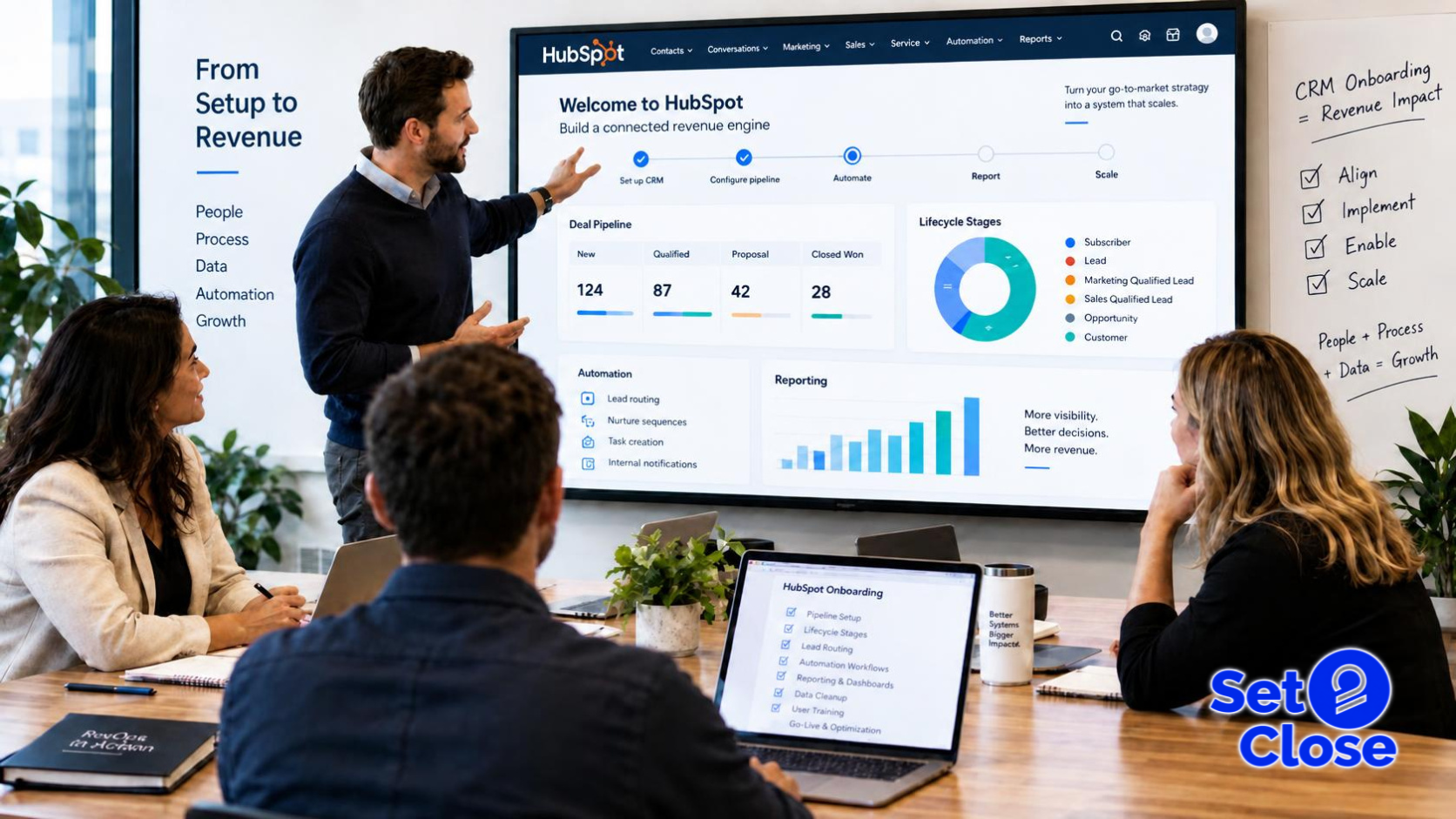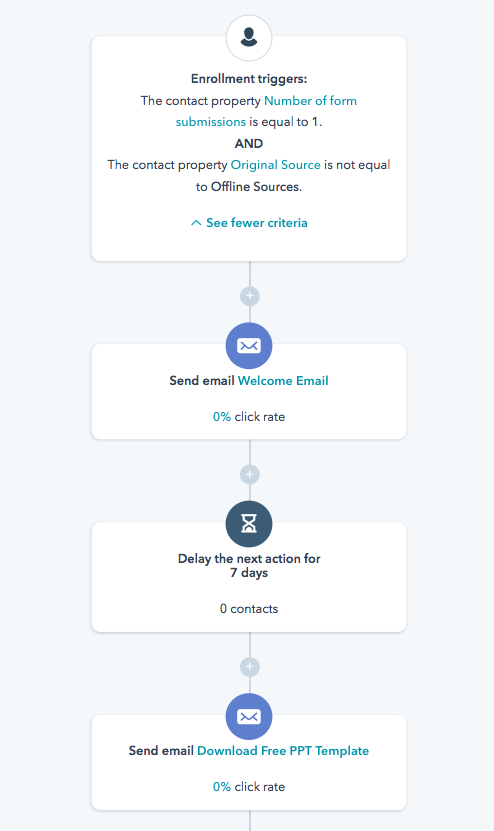
After HubSpot onboarding, B2B teams should expect a CRM their reps actually use every day, clean and deduplicated data, defined lifecycle stages, working lead routing, live automation, and dashboards that match how leadership already measures revenue. Adoption should be measurable within 90 days, not aspirational.
That is the bar. The gap between a portal that gets switched on and a revenue system that gets used is where most CRM implementations quietly fail. This guide breaks down the concrete operational, adoption, and alignment outcomes B2B SaaS revenue and operations leaders should expect from strong HubSpot implementation partners, how to verify each one, and what to do when they are missing.
What HubSpot Onboarding Should Deliver, in Plain Terms
Onboarding is not a training series. It is the moment your revenue operations stop living in spreadsheets, inboxes, and tribal knowledge and start living in one system. A capable partner leaves you with six things:
- A data model that reflects how your business actually sells, not HubSpot's default setup
- Contact, company, and deal records that are deduplicated, enriched, and trusted by the people using them
- Lifecycle stages and deal stages with written entry and exit criteria
- Lead routing and follow-up automation that runs without anyone babysitting it
- Dashboards your CEO, CRO, and board can read without a translator
- A team that logs activity because the system helps them, not because a manager is nagging them
If your engagement ended and you cannot point to all six, onboarding delivered software access rather than operational capability. Those are very different purchases.
The 30/60/90 Day Outcome Map
Strong HubSpot consulting engagements sequence outcomes deliberately. Data comes before process, process comes before automation, and automation comes before reporting. Skipping that order is the single most common reason a CRM implementation stalls at month four.
| Phase | What Should Be Live | How You Verify It |
|---|---|---|
| Days 1–30 | Migrated and deduplicated data, custom properties, pipelines with stage criteria, user permissions, core integrations | Run a duplicate report and a required-field audit; both should come back near zero |
| Days 31–60 | Lead routing, sequences, task automation, meeting links, role-based training completed | Weekly logged-activity rate per rep and percentage of deals created in-platform |
| Days 61–90 | Executive dashboards, forecast reporting, attribution, documented governance | Leadership runs the pipeline meeting from HubSpot with no offline spreadsheet |
Days 1–30: A Foundation You Can Trust
Clean, Deduplicated Data
Nothing kills CRM adoption faster than a rep opening an account and finding three versions of the same company. Expect your partner to audit source data before migration, standardize country and state values, normalize job titles, merge duplicates, and document what was intentionally left behind. You should receive a written record of what moved, what did not, and why.
A Data Model That Matches How You Sell
B2B SaaS companies rarely fit HubSpot's out-of-the-box object structure. Multi-product lines, land-and-expand motions, partner-sourced deals, and usage-based renewals all need deliberate property and association design. A partner who ships default properties is handing you technical debt that gets exponentially more expensive to unwind after 18 months of records pile on top of it.
Pipeline Stages With Exit Criteria
Every deal stage should have a written definition of what must be true for a deal to enter it. "Discovery" means a documented pain, an identified economic buyer, and a confirmed next step, not "we had a call." This is where forecast accuracy is either built or lost, and it is one of the sharpest differences between basic setup and a real Sales Hub implementation.
Days 31–60: Adoption, Not Just Access
Reps Working Deals Inside HubSpot
Access is a license. Adoption is behavior. By day 60, expect the majority of new deals to originate in HubSpot, calls and emails to log automatically, and reps to update deal records without being chased. If your team is still tracking their real pipeline in a personal spreadsheet, the implementation failed regardless of how clean the portal looks.
Role-Based Training That Sticks
Generic platform walkthroughs produce generic results. An AE needs to know how to run a sequence, book a meeting, and move a deal. A marketer needs list logic, workflow enrollment, and campaign attribution. A RevOps lead needs property governance and reporting architecture. Expect separate sessions, recorded for future hires, plus written documentation your team owns after the engagement ends. Programs like Fast Track onboarding are built around this done-with-you model specifically because training in isolation does not change behavior.
Automation That Removes Work
Good automation is invisible. Leads route to the right owner in seconds. Follow-up tasks generate themselves. Stale deals surface before they rot. Notifications fire to the right person at the right moment. If your team is manually assigning leads or rebuilding the same report every Monday, automation was under-scoped.
Days 61–90: Reporting Leadership Actually Trusts
One Source of Truth for Pipeline
The clearest signal that onboarding worked is a pipeline review run entirely from a HubSpot dashboard. No exported CSV. No side-by-side comparison against a board deck built in a spreadsheet. One number, one definition, one system.
Attribution That Survives Scrutiny
Your CMO should be able to show which campaigns influenced closed-won revenue and defend the methodology when finance pushes back. That requires consistent source tracking, campaign membership rules, and a defined attribution model chosen before reports get built, not retrofitted afterward. This is the connective tissue between marketing spend and revenue, and it sits at the heart of what revenue operations is meant to solve.
Forecast Accuracy Improves
You will not get perfect forecasting in 90 days. You should get a forecast that moves in the right direction and a documented reason whenever it misses. Stage-weighted probabilities, deal age tracking, and velocity reporting give leadership something to manage against instead of a gut-feel roll-up from sales managers.
Sales and Marketing Alignment: The Outcome Most Teams Skip
A Documented MQL-to-SQL Handoff
Sales and marketing alignment is not a workshop. It is a written agreement encoded in your CRM: what qualifies as an MQL, who owns the lead at each stage, how fast first response must happen, and what sales must do before rejecting a lead back to marketing. Expect that agreement to exist as a document and as workflow logic that enforces it.
Shared Definitions and a Feedback Loop
When marketing and sales use different definitions of a qualified lead, every downstream report is fiction. After onboarding, both teams should be working from one lifecycle model with a standing review where lead quality gets discussed against data rather than anecdote. That loop is what turns a CRM into a revenue engine instead of a filing cabinet.
B2B Marketing Automation: What Should Be Live at Handoff
For B2B SaaS teams running Marketing Hub alongside the CRM, a complete handoff includes more than a form and a welcome email. At minimum, expect:
- Lifecycle stage automation that advances contacts based on real behavior, not manual updates
- Lead scoring calibrated to your actual closed-won patterns
- At least one nurture track live per core segment or product line
- Form, list, and campaign naming conventions documented so the portal stays clean at scale
- Subscription types and preference management configured for compliance
- Tracking on every conversion point, including paid, organic, and partner sources
Partners with deep Marketing Hub experience build this as one connected system. Partners without it ship disconnected assets that look functional in a demo and break the first time a real campaign runs through them.
Onboarding vs. Implementation: Know Which One You Bought
A large share of post-onboarding disappointment traces back to a scope mismatch rather than poor execution. These are two different products, and confusing them sets expectations no engagement can meet.
| Dimension | Standard Onboarding | Full Implementation |
|---|---|---|
| Configuration | Out-of-the-box features enabled | Custom properties, objects, and associations built to your model |
| Who does the work | Guided; your team executes | Partner builds, you review and approve |
| Data migration | Basic import support | Mapped, cleansed, deduplicated, and validated |
| Process design | Minimal | Pipeline, routing, SLAs, and handoffs documented |
| Reporting | Default dashboards | Custom executive, forecast, and attribution reporting |
| Typical outcome | Platform access and familiarity | A working revenue system with measurable adoption |
If your growth plan depends on forecast accuracy and cross-team visibility, standard onboarding is a starting point rather than a finish line. Comparing the services different implementation firms actually deliver before you sign is the cheapest risk mitigation available to you.

9 Signs Your HubSpot Implementation Partner Did the Job Right
- Reps log in daily without being reminded, and deal records stay current.
- Duplicate records are rare and there is a documented process for handling new ones.
- Every deal stage has written entry and exit criteria your managers actually enforce.
- Leads route automatically with a measurable first-response time.
- Marketing can trace campaign influence to closed-won revenue.
- Leadership runs pipeline reviews directly from a dashboard.
- You own written documentation and recorded training for onboarding future hires.
- Your integrations sync cleanly with no manual reconciliation step.
- Your internal admin can make changes confidently without opening a support ticket.
Red Flags That Onboarding Fell Short
- Your team still runs the real pipeline in a spreadsheet
- Reports require manual cleanup before anyone will present them
- Nobody internally knows why a property or workflow was built the way it was
- Lead follow-up still depends on someone remembering to check a list
- Marketing and sales quote different numbers in the same meeting
- You received a portal walkthrough but no documentation you can hand to a new hire
None of these are fatal. All of them are fixable. But they need to be named quickly, because each additional month of messy data compounds the remediation cost.
Questions to Ask Before Your Onboarding Engagement Closes
- What specifically was configured, and where is that documented?
- Which records did not migrate, and what was the reasoning?
- Who on my team can independently modify workflows and properties today?
- What adoption metrics are we tracking, and what is our baseline?
- What did we intentionally defer to a later phase?
- What breaks first if we double headcount or add a second product line?
A confident partner answers all six in a single call. Hesitation on any of them tells you where the gaps are.
What Should Happen After Onboarding Ends
A CRM is not a project with a finish date. Pricing changes, new segments open, reps turn over, and your process evolves. Teams that sustain results treat HubSpot as an operating system under continuous management, with a quarterly review of data quality, pipeline definitions, automation performance, and reporting accuracy.
For most mid-market B2B SaaS companies, that means either a dedicated internal RevOps hire or an ongoing relationship with a partner who already knows your architecture. Both work. What does not work is walking away from a fresh implementation and expecting it to hold its shape for two years. If you are weighing the options, our breakdown of CRM consultants who combine inbound execution with RevOps strategy is a useful starting point.
Frequently Asked Questions
How long should HubSpot onboarding take for a B2B SaaS company?
Most focused engagements run four to eight weeks for core configuration, with adoption and reporting maturing across the first 90 days. Complex migrations involving custom objects, multiple integrations, or heavy historical data can extend to 12 weeks. Timelines longer than that usually signal unclear scope rather than genuine complexity.
What is the difference between HubSpot onboarding and HubSpot consulting?
Onboarding configures the platform and teaches your team to use it. Consulting designs the revenue process the platform is meant to support, including pipeline architecture, qualification criteria, routing logic, and reporting strategy. The strongest HubSpot implementation partners deliver both, because configuration without process design produces a tidy portal that does not change results.
How do I measure whether HubSpot onboarding was successful?
Track four things: percentage of deals created and updated in-platform, average first-response time on inbound leads, the count of duplicate and incomplete records, and whether leadership runs pipeline meetings from a HubSpot dashboard without an external spreadsheet. These four cover adoption, process, data quality, and trust.
Can we fix a bad HubSpot implementation without starting over?
Almost always. Remediation typically begins with a data and architecture audit, then rebuilds the data model and pipeline definitions before touching automation. Full portal rebuilds are rare and usually reserved for cases with severe object-level design problems. The cost scales with how long the issues have been accumulating records, which is why acting early matters.
Do we need a partner if HubSpot offers onboarding directly?
HubSpot's onboarding is guided and generalized across industries. A specialist partner builds around your specific go-to-market motion, handles migration and integration work directly, and stays accountable for adoption outcomes. If your sales process is simple and you have internal admin capacity, the direct route can be sufficient. If revenue depends on forecast accuracy and cross-functional alignment, the specialist route pays for itself. Our comparison of partners serving B2B SaaS companies covers how to evaluate the difference.
The Bottom Line
After HubSpot onboarding, you should have a revenue system your team uses by choice, data your leadership trusts without verification, and a clear line from marketing activity to closed revenue. Anything short of that is an unfinished implementation, not a completed one.
Set2Close is a HubSpot Elite Partner that builds CRM implementations around revenue operations outcomes rather than feature checklists. If you are planning an onboarding, recovering from one that underdelivered, or trying to get more out of a portal you already own, talk to our team about what a RevOps-first build should look like for your business.
Related Articles